King Harald's sarcophagus is in place in the mausoleum
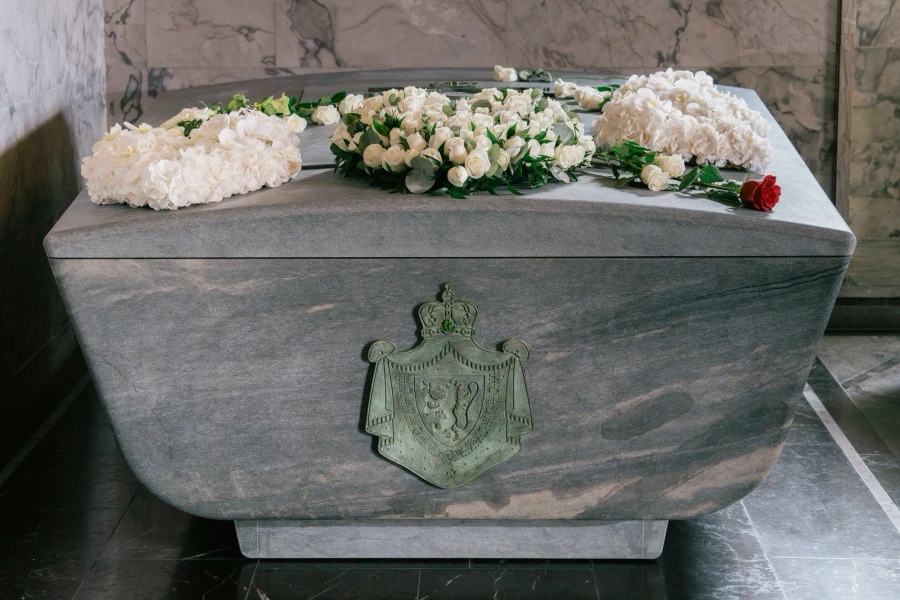
Photo: Ola Vatn, The Royal Court
King Harald V's final resting place is in the Royal Mausoleum at Akershus Castle. The sarcophagus is shaped like a vessel, inspired by the King's relationship with the sea, and is made of olivine stone from Sunnmøre. The Norwegian regalia are depicted in bronze on the lid.
King Harald V's final resting place is in the Royal Mausoleum at Akershus Castle. A third sarcophagus is now in place, beside those of King Olav and Crown Princess Märtha and of King Haakon VII and Queen Maud.
King Harald's sarcophagus in the Royal Mausoleum. Photo: Ola Vatn, The Royal Court
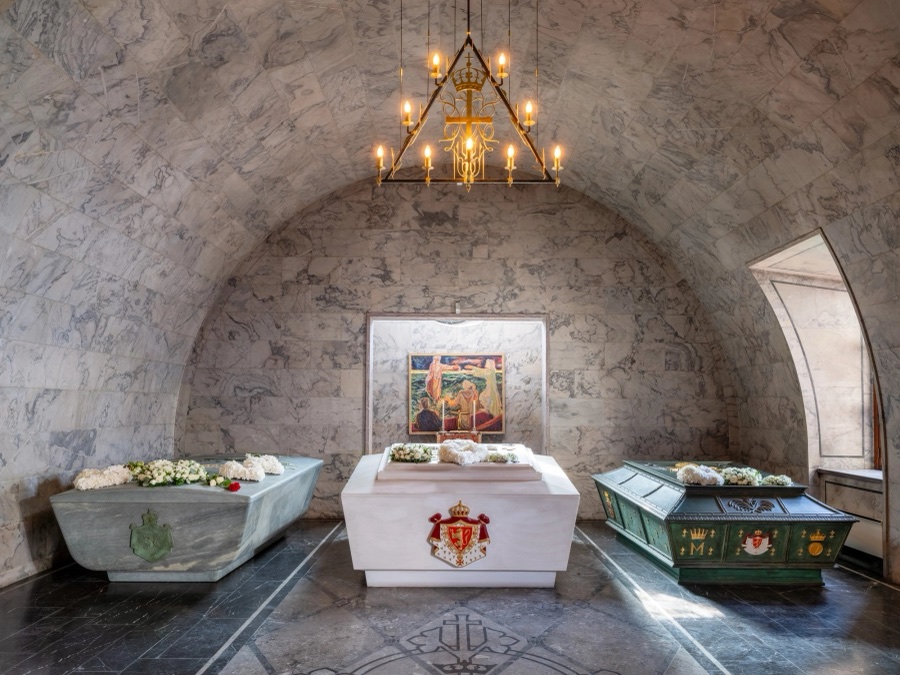 The three sarcophagi in the Royal Mausoleum. Photo: Øivind Möller Bakken, The Royal Court
• Shaped like a vessel
The new sarcophagus is shaped like a vessel with a rounded bottom, inspired by King Harald's close relationship with the sea. The hull protects what is on board and carries it safely onward.
The motif also draws a line back through history, towards the ship burials of earlier times, when the ship carried the dead on a final journey to another realm.
• Stone from Sunnmøre
The material is olivine stone, a rock formed in the interior of the earth and pushed up by the same forces that shaped Norway.
Just as King Harald's life at sea shaped the design, Queen Sonja's relationship with Norwegian nature has been an important inspiration. She has taken countless walks in the Norwegian countryside, on foot and on skis, across the whole country. Norwegian stone was therefore the natural choice, and the stone was taken from Sunnmøre, an area the Queen has walked in a great deal and knows very well.
The greenish olivine stone can absorb and bind CO2. The designers have emphasised this as a symbol of the King and Queen's love of nature and their care for coming generations.
The sarcophagus thus brings together what has been important to each of them, in a shared resting place.
• The regalia on the lid
On the lid are symbols of the Norwegian regalia: the royal crown, the orb, the sceptre and the sword of state. At the foot end the royal coat of arms is depicted.
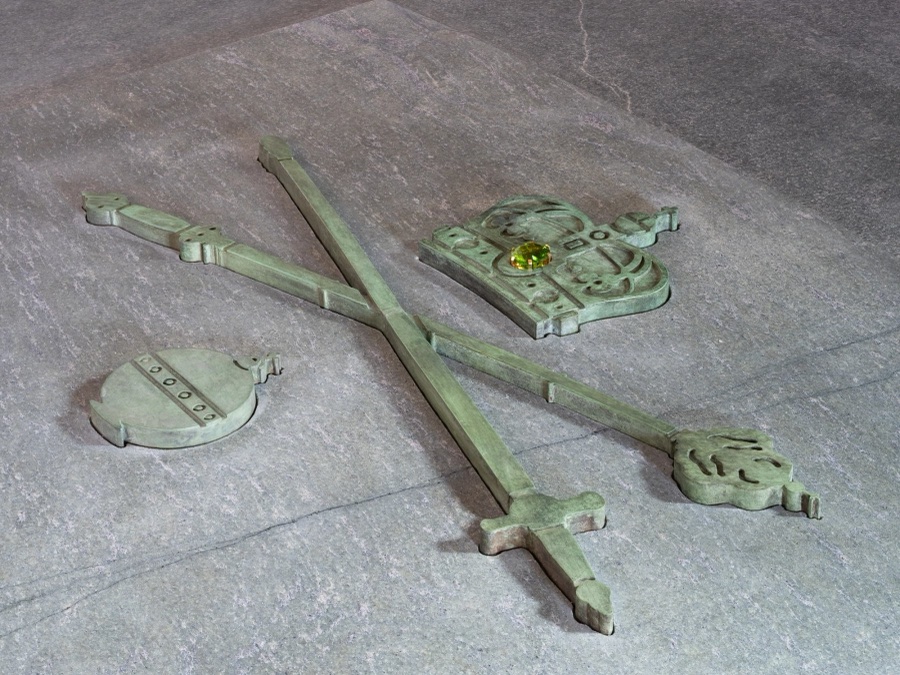 The Norwegian royal crown, sword of state, sceptre and orb are depicted on the lid. Photo: Øivind Möller Bakken, The Royal Court
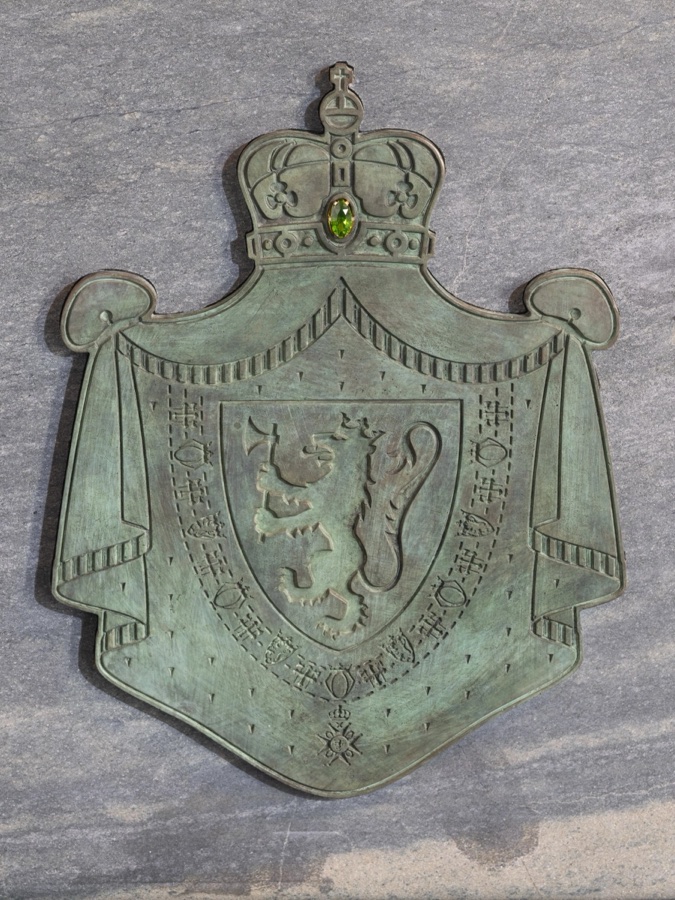 The royal coat of arms is cast in bronze and depicted at the foot end of the sarcophagus. Photo: Øivind Möller Bakken, The Royal Court
The ornaments are set partly into the stone. The symbols are handmade and cast in bronze.
• The green gemstone
Set into the two crowns is the green gemstone peridot. Peridot is also found on the arches of the royal crown itself.
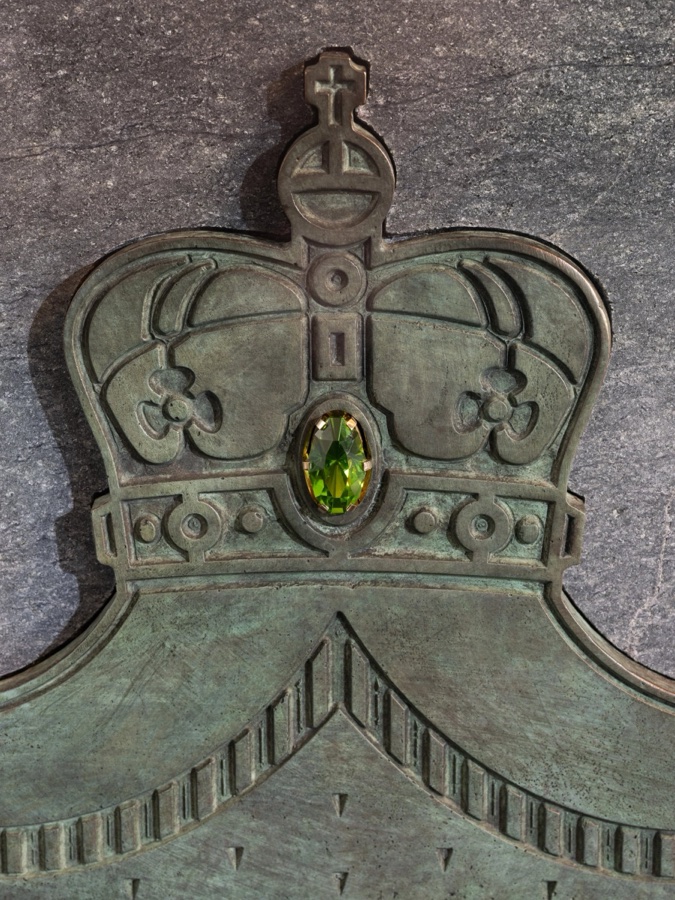 A peridot adorns the crown in the sarcophagus's coat of arms. Photo: Øivind Möller Bakken, The Royal Court
Olivine stone has green tones and fine veins, and takes its name from its olive-green colour. It consists mainly of the mineral olivine, and peridot is the green, clear gemstone variety of the same mineral.
The stone was formed deep beneath the surface of the earth and lifted up by tectonic forces around 400 million years ago. Erosion eventually brought it all the way to the surface. The stone in the sarcophagus was thus created by the same geological forces that shaped the mountains, the fjords and the landscape around us.
• The letters in gold
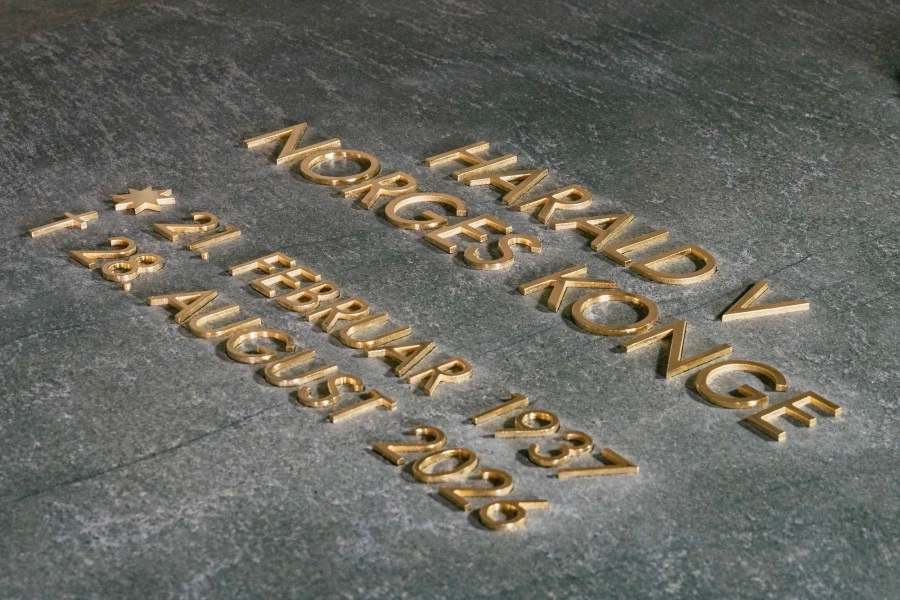 Each letter is cut from brass, gold-plated and set partly into the surface. Photo: Ola Vatn, The Royal Court
Each letter of the text is cut from brass and gold-plated. The typeface is Futura, created by Paul Renner in the 1920s.